Master Search Intent for Better SEO and Engagement
SEO isn’t just about keywords anymore; it’s about solving real problems. Ranking high on Google improves visibility, but search intent is what keeps users on your page and drives results. If your content doesn’t match what people are actually looking for, they’ll leave in seconds. Understanding intent helps you create content that answers questions, provides value, and encourages users to take action.
Today, AI-powered tools make it easier than ever to analyze user behavior, identify search intent, and optimize content for maximum relevance. This guide will show you how to master intent-based optimization, boost engagement, build trust, and outrank competitors by being the most relevant answer on the web.
Why Search Intent Really Means for Your Content?
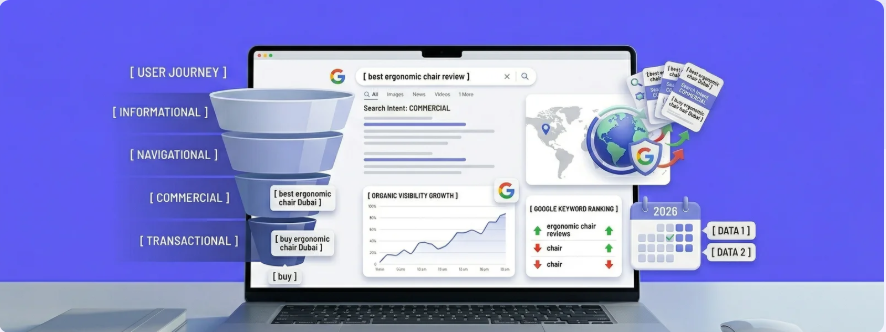
Search intent shows why users search, helping you create content that truly addresses their needs. Aligning your pages with intent ensures visitors find relevant, valuable information, increasing engagement and trust. Instead of just targeting keywords, understanding intent allows your content to answer questions effectively, satisfy user expectations, and improve SEO performance. Below are the 4 main types of search intent:
The Four Main Pillars of Intent
Most queries fall into one of these 4 categories:
- Informational: The user is looking for knowledge/information or an answer to a specific question.
Examples:
- What is Search Intent?
- How to change a tire?
- Capital of France.
- Navigational: Navigational intent refers to a search query in which the user aims to access a particular website, brand, or page instead of looking for information. These individuals are already aware of their destination and utilize a search engine as a quick way to go directly there.
Examples
- Facebook login
- SEO Service New Orleans blog
- OpenAI ChatGPT login
- Commercial Investigation: The user is in the market for a product or service but hasn’t made a final decision. They are researching and comparing.
Examples
- Best SEO tools 2026
- Porsche 911 vs. Audi R8
- Top-rated DSLR cameras
- Transactional: The user is ready to buy. They have their credit card out and are looking for the right place to make the purchase.
Examples
- Buy iPhone 17 Pro
- SEO agency Dubai contact
- Discount codes for Nike
Understanding Semantics in Search
Before diving deeper into search intent, it’s important to understand semantics—the study of meaning in language. In search, semantics isn’t just about the words a user types; it’s about grasping the actual meaning behind a query. This understanding is what allows search engines to interpret searches the way humans naturally think.
How do Search Engines Use Semantics to Decode Intent?
Search engines can’t predict what a user wants unless they first understand the meaning of their query. Semantics bridges this gap, helping platforms like Google go beyond literal keyword matches. With semantic understanding, search engines can recognize:
- Synonyms and Equivalent Phrases:g., “budget smartphone” vs. “affordable phone”
- Context for Ambiguous Terms:g., “Java” (coffee, programming language, or island)
- Relationships Between Entities: brands, people, concepts, and products
- Variations in Phrasing:g., “how to fix a leaking tap” vs. “leaking faucet repair”
By understanding the meaning behind words, search engines can better predict user intent, whether the user is looking for information, a comparison, or a product page.
Modern AI models take this even further. They analyse context across entire sentences, connecting words, identifying relationships, and understanding subtle shifts in intent throughout a user’s search journey.
In short, semantics explains the language, while search intent explains the goal. Together, they allow search engines and AI tools to deliver content that truly meets user needs.
1. Informational Intent
Informational intent occurs when users search to learn something or find answers. These queries often begin with phrases like “how to,” “what is,” or “why” and may involve direct questions, concept exploration, or general learning.
Examples:
- How to train a puppy
- Benefits of meditation
- Paris tourist attractions
- Elon Musk net worth
Google excels at understanding the context behind these searches. For instance, someone searching for “chocolate cake” likely wants recipes, not the history of cocoa, and “Saturn” usually returns results about the planet rather than the Roman god.
Optimizing for Informational Intent
- Clear answers: Always provide complete and straightforward responses that fully address the user’s question and satisfy their search intent.
- Simple structure: Use headings, short paragraphs, and visuals to make content easy to read and understand for all users.
- Build trust: Focus on establishing authority and credibility so users feel confident in the accuracy of your content.
- User understanding: Help visitors grasp the topic thoroughly before they move on to the next step in their journey.
2. Navigational Intent
Navigational intent occurs when users search intending to reach a specific website or page. Instead of typing a full URL, they rely on Google as a shortcut to quickly access the destination they already have in mind.
Examples:
- LinkedIn login
- Canva homepage
- Shopify dashboard
- Adobe Photoshop download
These searches often include brand names, product names, or service names. If your audience is looking for your company, your website must appear promptly and accurately in search results.
Why Navigational Intent Matters?
Not all navigational rankings are beneficial. For instance, if a user searches for “Spotify” but lands on a third-party review site instead of Spotify’s official page, the result doesn’t serve the user or the business. Ranking for navigational queries is only valuable when users are specifically trying to reach your site.
How to Optimize for Navigational Intent?
- Branded Pages First: Ensure your homepage, login pages, and main product pages are easily discoverable.
- Use Clear Site Structure: Make sure key pages are well-organized and accessible.
- Optimize for Branded Keywords: Include your brand name in page titles, meta descriptions, and headers.
For deeper insights, check out our recorded webinar on “Creating Product Pages That Convert,” where we share actionable tips for building high-performing, user-focused pages.
3. Commercial Intent
Commercial intent occurs when users are exploring and comparing products or services but are not yet ready to make a purchase. They are in the research phase, looking for guidance to help them make an informed decision.
These searches often include terms like “best,” “top,” “review,” “compare,” or “alternatives.” Users are actively weighing options and seeking expert advice, but they haven’t committed to buying yet.
Examples:
- Best noise-cancelling headphones
- iPhone 15 vs Samsung Galaxy S25/S26
- Affordable electric cars 2026
- Alternatives to Canva Pro
- Top WordPress security plugins
These queries reflect a strong interest and intent to purchase eventually. Users want honest comparisons, detailed reviews, pros and cons, and reassurance from credible sources before making their choice.
How to Optimize for Commercial Intent?
- Create Comparison Guides: Highlight differences between products or services to help users evaluate options.
- Write Reviews and Roundups: Provide thorough, unbiased reviews of features, benefits, and drawbacks.
- Answer Key Questions: Address concerns or common queries buyers have during their research.
- Build Trust: Offer valuable, transparent information to position your brand as a reliable expert before users reach the decision stage.
4. Transactional Intent
Transactional intent occurs when users are ready to take action, typically to make a purchase, subscribe to a service, or download a product. These searches indicate a high likelihood of conversion, as users know exactly what they want.
Transactional queries often include words like “buy,” “order,” “subscribe,” “download,” or the specific product or service name.
Examples:
- Buy iPhone 17 Pro Max online
- Subscribe to Adobe Creative Cloud
- Grab Spotify Premium discount
- Order ergonomic office chair
- Download Canva Pro
Users with transactional intent expect to land directly on the relevant page and complete their action quickly, without distractions or unnecessary steps.
How to Optimize for Transactional Intent?
- Clear Calls-to-action: Make buttons and links direct and easy to understand.
- Detailed Product Information: Include specs, features, pricing, and benefits.
- Streamlined Conversion Paths: Simplify checkout, signup, or download processes.
- Use Intent-focused Keywords: Target terms that match the user’s buying or conversion intent.
Mixed Intent
Not every search fits neatly into a single category. Some queries show a combination of two or more intents, known as mixed intent. These are common because real users rarely follow a perfectly linear path.
A searcher might be looking for information while also considering a purchase, or they may want comparisons alongside direct product options. Mixed intent usually occurs with broad, ambiguous, or highly popular keywords that attract users at different stages of their journey.
Examples:
- Best laptops for college students
- Beginner running shoes
- Coffee maker reviews and comparisons
- Top smartphones in 2026
- Affordable DSLR cameras
These searches often blend informational and commercial investigation intent. Users may want to learn features, read reviews, compare options, and eventually make a purchase. As a result, Google’s SERPs often show a mix of content types: buying guides, reviews, tutorial videos, and direct product listings.
How to Optimize for Mixed Intent?
- Answer Key Questions: Provide clear, informative content to satisfy curiosity.
- Include Comparisons: Highlight pros, cons, and alternative options.
- Guide Toward Conversions: Link to relevant products or services naturally.
- Organize Content Clearly: Use headings and subheadings for easy scanning.
- Use Internal Links: Direct users to detailed resources or product pages.
Mixed intent signals that users are exploring, learning, and evaluating their options. By creating content that serves multiple purposes, you meet diverse needs, encourage engagement, and increase your chances of ranking for different variations of the keyword.
Understanding How Google Defines Search Intent
Google’s search quality evaluator guidelines categorize user intent into four main types, which align closely with SEO’s approach:
- Know: Users are looking to learn something or find answers.
- Do: Users want to take an action, such as making a purchase or completing a task.
- Website: Users are trying to reach a specific website or page.
- Visit in Person: Users are seeking a physical location, store, or business.
This framework translates neatly into SEO strategies, helping you create content that matches what users actually want.
| Search Intent | What Users Want | Best Content Formats | Examples |
| Informational (Know) | Learn about a topic or find answers | Guides, tutorials, blog posts, FAQs | How to start a vegetable garden, What is artificial intelligence? |
| Navigational (Website) | Reach a specific site or page | Homepage, login page, branded content | LinkedIn login, Canva homepage, Shopify dashboard |
| Commercial (Know/Do) | Research options before making a purchase | Reviews, comparisons, buying guides | Best noise-cancelling headphones, iPhone 17 vs Samsung Galaxy S25, Top electric cars 2025 |
| Transactional (Do) | Complete an action like buying, subscribing, or downloading | Product pages, landing pages, checkout flows | Buy an ergonomic office chair online, Subscribe to Adobe Creative Cloud, Download Canva Pro. |
Matching Content to User Intent: Know What Your Audience Wants
Once you know the different types of search intent, the next step is to understand your audience and deliver exactly what they’re looking for. Matching intent isn’t about guesswork; it’s about observing behavior, analyzing search patterns, and interpreting signals from both your site and the SERPs. A simple starting point is to ask: “What is the user hoping to accomplish with this search?”
Sometimes the answer is straightforward, but often queries are ambiguous. Two people might use the same keyword but expect completely different results. That’s why audience research is crucial. You can gather insights by:
- Reviewing search terms and behavior in your analytics tools.
- Collecting frequently asked questions from customers.
- Running quick, non-intrusive surveys or polls, such as “What were you hoping to find today?”
Another reliable method is to analyze the search results themselves. Google’s SERPs are a direct reflection of user intent:
- If the top results are guides, tutorials, or FAQs, the intent is likely informational.
- If you see reviews, comparisons, and roundups, the intent is commercial investigation.
- If product pages, checkout links, or service landing pages dominate, the intent is transactional.
Regularly studying SERPs and user behavior helps you align your content with what users truly want, improves engagement, and increases the likelihood of conversions.
Align Content with User Intent for Maximum Impact
Turn clicks into conversions with SEO Service New Orleans by mastering search intent. Understanding what users want allows you to create content that informs, engages, and drives action. Tutorials, guides, comparisons, and product pages aligned with intent build trust and keep visitors on your site longer.
Optimize for intent today and make your content the go-to resource your audience is seeking. Meeting informational, commercial, navigational, or transactional needs boosts engagement, conversions, and real results.
Frequently Ask Questions
What is search intent and why does it matter for my website?
Search intent is the reason a user performs a search, like looking for information, comparing products, or making a purchase. Understanding intent helps you create content that matches user expectations, increases engagement, and improves your website’s SEO performance.
Why choose SEO Service New Orleans to optimize for search intent?
At SEO Service New Orleans, we specialize in intent-based optimization. Our strategies ensure your content satisfies user needs at every stage, from learning to buying, helping your brand rank higher and drive measurable results.
Can optimizing for search intent improve my conversions?
Yes! Aligning your content with user intent ensures visitors find exactly what they’re looking for. This builds trust, keeps users on your site longer, and increases the likelihood of actions like purchases or sign-ups.
How can I identify the search intent of my target audience?
Analyze search terms in Google Analytics, study SERPs for your keywords, and review questions your audience asks. Observing behavior and patterns helps you determine whether queries are informational, navigational, commercial, or transactional.
Closing of the Guide
Understanding search intent is essential for creating content that truly resonates with your audience. By recognizing why users search and what they hope to achieve, whether learning, comparing, or buying, you can craft pages that meet their needs at every stage of the journey.
Aligning content with intent improves engagement, builds trust, and increases the likelihood of conversions. Informational content educates, navigational content guides, commercial content helps users evaluate options, and transactional content drives action.
Even mixed-intent queries can be addressed effectively with clear structure, comparisons, and actionable links. Regularly analyzing search patterns, SERPs, and user behavior ensures your content stays relevant, valuable, and effective. By mastering search intent, you transform clicks into meaningful interactions that benefit both users and your overall SEO performance.